Intervention Services
A carefully designed conversation, not a confrontation — for families ready to ask their loved one to choose change.
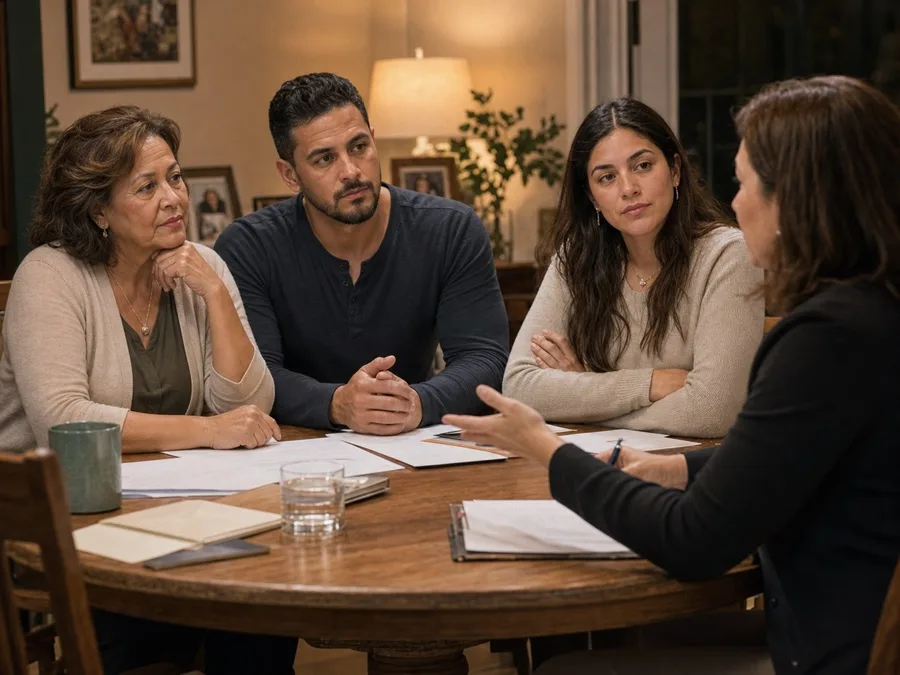
How the work actually goes.
An intervention is a structured family conversation, planned and led by a trained professional, that asks a loved one to accept help. It is not a surprise attack and it is not a script. It is the result of days or weeks of preparation with the people who love this person most.
My approach draws on the Love First and ARISE® models. We begin with the family, not the crisis. Together we map what is happening, agree on a clear ask, write letters that say what most needs saying, and rehearse until the room feels steady.
On the day of the meeting, I am with you. After the meeting — whether your loved one accepts help that day or three weeks from now — I stay involved. The intervention is the beginning of a longer relationship with the family, not a one-time event.
The shape of the engagement.
- 01A complimentary first call to understand what is happening and whether an intervention is the right next step
- 02One to three preparation sessions with the family team, in person or by video
- 03A coordinated intervention meeting led by Gianna, with treatment placement arranged in advance
- 04Continued family support and case management through the first weeks after
Common questions about intervention services
What does a Certified Intervention Professional actually do?
A Certified Intervention Professional (CIP) plans, facilitates, and follows through on the structured conversation a family has with a loved one about getting help. The work begins long before the day itself — we meet with the family to understand the situation, identify who should and shouldn't be in the room, prepare each person on what to say and how to say it, and confirm a treatment plan is ready to start the same day. Our credential is recognized by the Association of Intervention Specialists and signals adherence to a professional code of ethics.
How long does a family intervention take?
From first call to the intervention itself usually takes 1–3 weeks. The preparation work — family sessions, planning, coordinating a treatment placement, rehearsals — is where most of the time goes. The intervention conversation itself typically lasts 60–90 minutes. After the loved one accepts help, our involvement often continues for weeks or months as they enter treatment and the family begins its own recovery work.
Will my loved one be angry that we staged an intervention?
Sometimes — and we plan for it. A well-prepared intervention is not an ambush; it's a structured conversation conducted with love and clarity. Most loved ones, when they realize the people they care about most are unified in concern, are more relieved than angry. The ARISE® invitational model we draw from specifically invites the loved one into the conversation rather than surprising them, which significantly reduces resistance.
What if our loved one says no?
A 'no' on the day is not the end of the work. Studies show that 80–90% of professionally-conducted interventions ultimately result in the loved one accepting help, sometimes weeks or months later, because the family changes how it responds. We don't leave families on their own after a 'no.' We help establish boundaries the family is prepared to hold, and we stay engaged as the situation evolves.
What's the difference between an intervention and an ultimatum?
An ultimatum is a single person making a single threat in a moment of frustration. An intervention is a structured, prepared, professionally-facilitated conversation involving the whole family system, with a treatment placement ready and a clear path forward. The goal isn't to deliver consequences — it's to remove the barriers that have kept your loved one stuck. Interventions are about love and clarity; ultimatums are usually about control.
Do you only work with families dealing with alcohol or drug addiction?
No. We work with families facing addiction in all its forms (alcohol, opioids, stimulants, cannabis, gambling, food, sex), as well as complex mental-health crises (severe depression, bipolar disorder, schizophrenia, trauma, dual diagnosis). Many families we meet are navigating more than one of these at once. Our family-systems approach applies regardless of the specific diagnosis.
Start with the situation as it is.
You do not need to know whether your family needs intervention, coaching, treatment navigation, or long-term support before reaching out. That is part of the work.